What to reconcile before month-end close
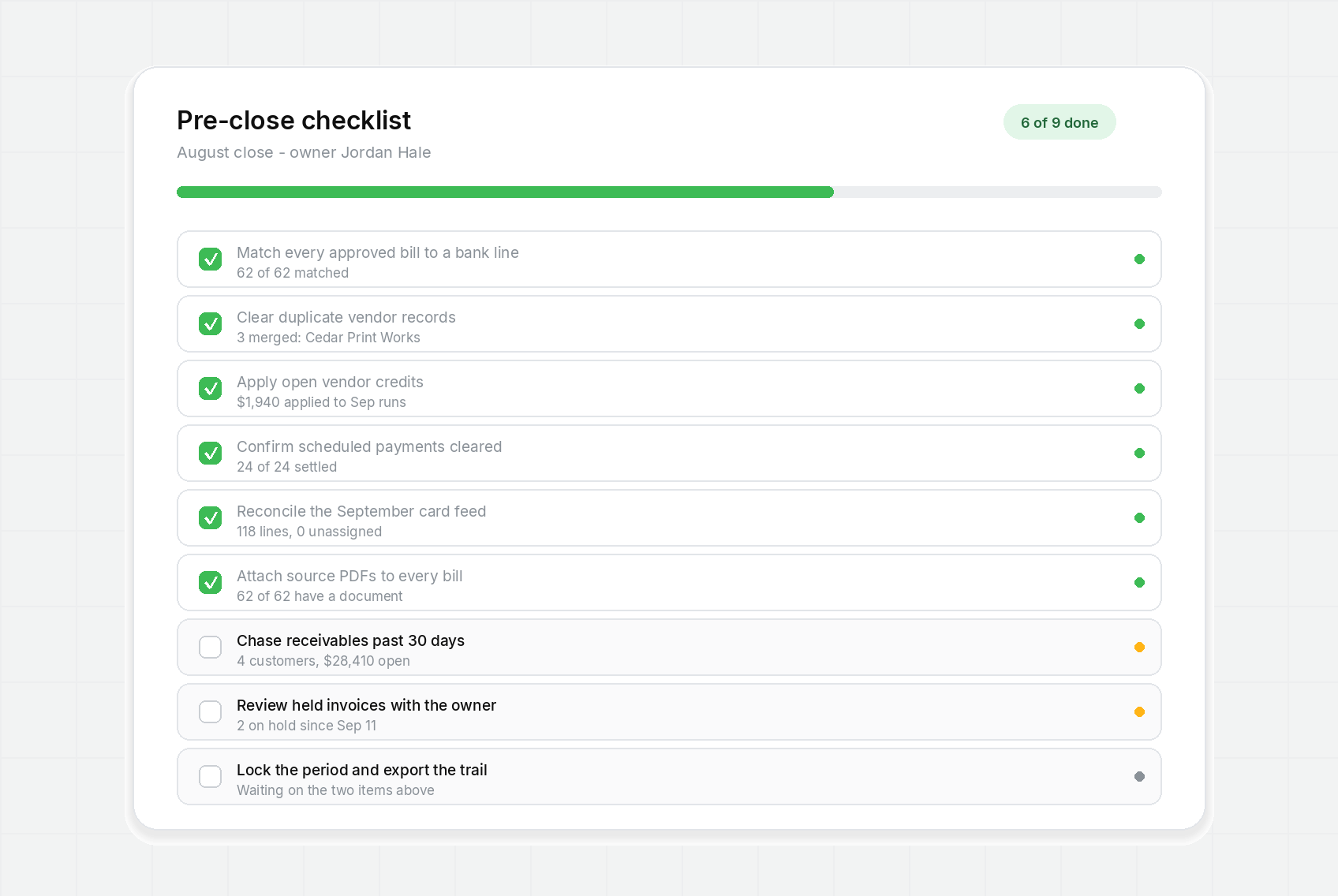
Close gets hard when the reconciliation work starts on the first of the month. By then the queues have moved on, the people who know what happened are working on something else, and every question costs a message.
The alternative is not more effort. It is earlier effort. Most of what makes a close painful can be cleared in the last week of the month, while the records are still warm and the answers are still obvious.
What follows is the order that works: payables, then credits and exceptions, then receivables, then the trail. Doing it in that order matters, because each phase removes noise from the next one.
Phase one: payables against the bank
Start where the money left. Every approved payment should match a bank line, and anything unmatched should be named before it becomes an adjustment.
- Match scheduled payments to cleared bank lines on amount and date.
- List partial payments separately. They are not exceptions, they are open balances.
- Check for any payment that cleared without an approval on the record.
- Confirm the last run of the month is either settled or deliberately held.
Phase two: credits, duplicates, and held invoices
This is the phase everyone postpones, which is why it shows up as a surprise. Credits and duplicates do not resolve themselves, and a held invoice that nobody revisits turns into an accrual argument.
- Apply open vendor credits to the next scheduled payment, not to a memory.
- Merge duplicate vendor records before they produce a duplicate payment.
- Give every held invoice a reason and a date it will be looked at again.
- Resolve anything flagged as a possible duplicate, one way or the other.
Phase three: receivables you actually expect
Receivables is where optimism enters the close. An invoice with net 30 terms and a customer who always pays at 52 days is not a thirty-day receivable, and pretending otherwise moves the problem into next month.
- Update the expected collect date on anything past terms.
- Separate disputed invoices from slow ones. They need different work.
- Record the next action and the owner for every customer past thirty days.
- Compare what you expected to collect this month against what landed.
Phase three and a half: the things most lists skip
Three items fall between the standard phases, and they are the ones that produce the awkward questions later.
- Employee reimbursements and card spend, which arrive late and rarely have an approval trail.
- Intercompany or owner transactions, which are small in count and large in consequence.
- Any vendor whose banking details changed during the month, confirmed against the payment that actually went out.
Phase four: the trail
The last phase is not about numbers. It is about whether someone can reconstruct a decision six months from now without calling you.
- Confirm every bill has its source document attached.
- Confirm approvals are on the record, with names and timestamps.
- Note anything unusual while the reason is still fresh.
- Lock the period once the first three phases are clear.
Who owns each phase
The phases only work if each one has a single name against it, and the names should be different people wherever headcount allows. The person who schedules payments should not be the only person who reconciles them.
In a small team that separation is not always possible, and pretending otherwise helps nobody. If one person does both, the control is a review: someone else looks at the matched list once a month and signs that they looked. That is a real control as long as the review is recorded.
A realistic shape for the last week
Spread across four working days, none of these phases takes long. Compressed into the first of the month, all of them take longer than they should, because every unanswered question turns into a message and a wait.
Phase one usually takes an hour if the matching has been current all month, and half a day if it has not. Phase two is the variable one, because it depends on how many exceptions accumulated. Phase three takes as long as the conversations take, which is why starting it before month-end matters most. Phase four is short by design, and if it is not, the earlier phases were not finished.
What to do about the items that never clear
Every close has a handful of items that do not resolve: a credit the vendor disputes, a customer payment applied to the wrong invoice two quarters ago, a duplicate that was already paid. Carrying them silently is the expensive choice, because next month they are older and nobody remembers the context.
Give them a short list of their own, with an owner and a date. Review that list at the start of each close rather than at the end. Most of them clear within two months once someone owns them, and the ones that do not are a real decision you should be making on purpose.
Why earlier is cheaper
Reconciling during the last week of the month costs less than reconciling after it, and not by a small margin. The invoices are recent, the approvers remember the conversation, and the vendor is still answering email about it.
It also changes what close feels like. When the queues are current, the first of the month is a review rather than an investigation. Control keeps payables, receivables, and payment runs in the same place all month, so the pre-close list is something you work down rather than something you assemble. Your ledger stays where it is. What changes is how much of the work is already done when you get there.
Get payment alerts by text
Account notifications for payments, invoices, and cash flow warnings. No promotional messages.